
Big Small Game on Club 6E: 5 to 9 or 0 to 4, the Pick That Breaks Even
Checked · Club 6E guide
The Big Small game is the simplest pick on the Club 6E board. Each round ends with a single digit, and the ten possible digits are split down the middle: the upper five (5 through 9) count as Big, the lower five (0 through 4) count as Small. Choose a side, and if the digit lands on it you get back twice the coins you placed. Half the digits sit on each side, so the chance is an even 50% every time.
That even split makes it the only pick with no built-in edge, which is why so many people start with it and why so many bad ideas grow around it. This guide shows how every digit settles, works through the streak maths with real numbers, lets a doubling plan fail on paper before it fails on a screen, and explains how to try all of it with practice coins that reset for free.
What the Big Small game is
On the colour prediction board, under the colour buttons and the ten numbered balls, sit two wide buttons: Big and Small. Together they form the Big Small game, a size pick that ignores colour completely and asks one question about the digit to come: is it in the upper half or the lower half?
Every room runs it the same way. You can place or add picks until five seconds before the round ends, your own phone then generates the digit through the browser's secure random source, and the pick settles at once. A 100-coin pick on Big returns 200 coins when the digit is 5 to 9 and 0 coins when it is 0 to 4. Small is the mirror image. Both sides pay the same, both sides cover five digits, and there is no fee taken off a win.
The pick lives inside the main game, so everything about rooms, chips and the period number in the full rules of the colour prediction game applies here too. This page only goes deep on the size pick itself.
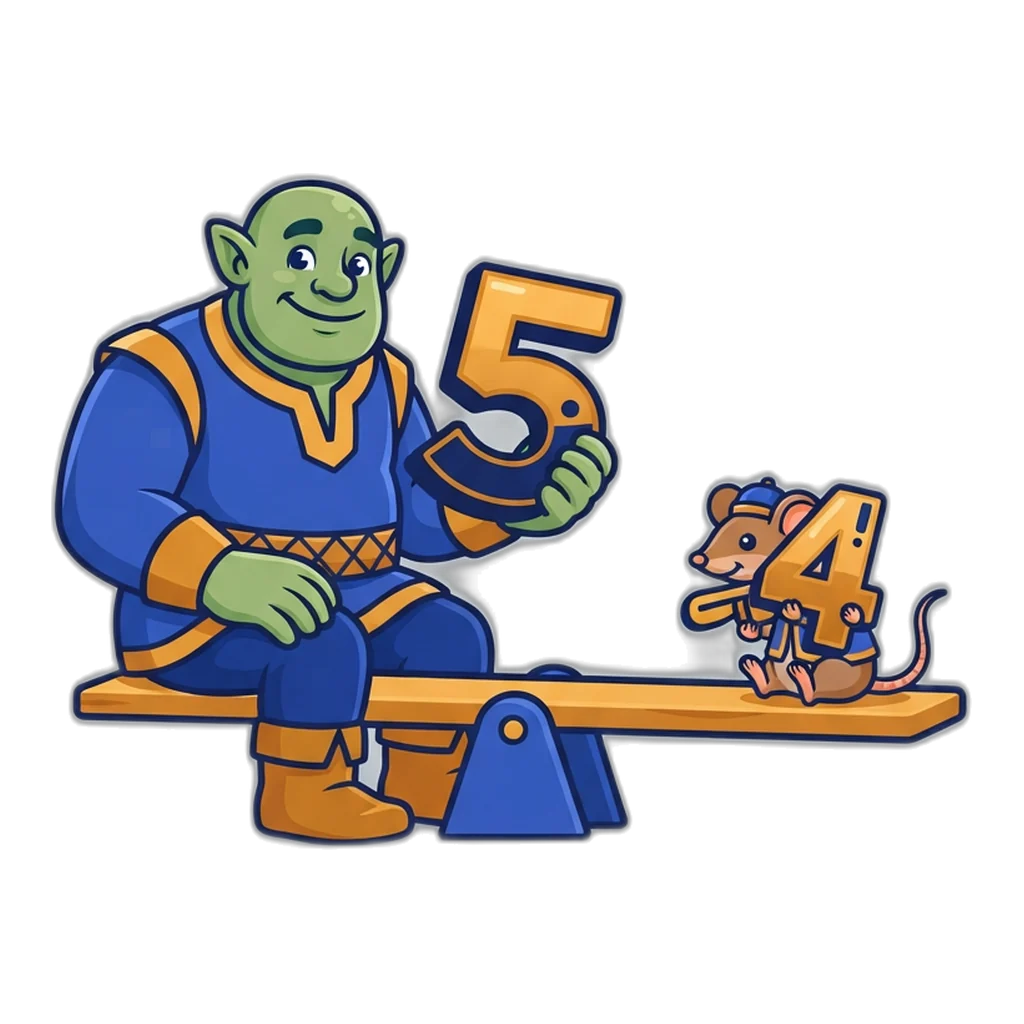
How every digit settles in the Big Small game
The table comes from the game's own rule file. The colour column is there for context, because many players place a colour pick and a size pick on the same round and want to see how one digit settles both.
| Digit | Side | Colour | Settlement |
|---|---|---|---|
| 0 | Small | Red + Violet | Small returns 2x, Big returns nothing |
| 1 | Small | Green | Small returns 2x, Big returns nothing |
| 2 | Small | Red | Small returns 2x, Big returns nothing |
| 3 | Small | Green | Small returns 2x, Big returns nothing |
| 4 | Small | Red | Small returns 2x, Big returns nothing |
| 5 | Big | Green + Violet | Big returns 2x, Small returns nothing |
| 6 | Big | Red | Big returns 2x, Small returns nothing |
| 7 | Big | Green | Big returns 2x, Small returns nothing |
| 8 | Big | Red | Big returns 2x, Small returns nothing |
| 9 | Big | Green | Big returns 2x, Small returns nothing |
Why 5 is Big
People often expect 5 to be the middle, neither Big nor Small. But there are ten digits, not nine, so there is no single middle digit. Counting from 0, the first five digits are 0, 1, 2, 3 and 4 and the second five are 5, 6, 7, 8 and 9. Big starts where the second half starts. If 5 were left out, Big would cover four digits and the two sides would stop being equal, which is exactly the fairness the pick is built on.
Zero and five carry two colours each and are the only digits where violet pays, but for the Big Small game they are ordinary members of their side: 0 is Small, 5 is Big, nothing more.
Why 2x at 50% breaks even
Here is the sum in full. Place 100 coins on Big. Five digits out of ten return 200 coins; five return 0. The average is 0.5 × 200 + 0.5 × 0 = 100 coins, the same as the 100 you placed. Over a very long run of rounds, coins placed on the Big Small game come back, on average, exactly as they went in. Nothing leaks out, and nothing is added.
Green, by contrast, averages 95 per 100 (four tenths of 200 plus one tenth of 150), and a number pick averages 90 (one tenth of 900). The size pick is the only line on the board that lands on 100. That is a genuine point in its favour, and it is also where people go wrong, because "no edge" is not the same as "no risk" or "slow and steady gain".
Breaking even still swings
Breaking even is a statement about the average over thousands of rounds, described by the law of large numbers. It says nothing about the next hundred. In 100 rounds at 100 coins each, the number of wins is usually between 46 and 54, but it drifts outside that band more than a third of the time.
| Wins out of 100 | Net change in coins | How often |
|---|---|---|
| 40 or fewer | −2,000 or worse | about 3 in 100 |
| 41 to 45 | −1,800 to −1,000 | about 16 in 100 |
| 46 to 54 | −800 to +800 | about 63 in 100 |
| 55 to 59 | +1,000 to +1,800 | about 16 in 100 |
| 60 or more | +2,000 or better | about 3 in 100 |
Roughly one session in six ends down a thousand coins or more, and one in six ends up by that much, with no edge involved at all. A player who keeps going until the balance is back where it started will, more often than people expect, spend a whole evening doing it. The maths is fair; the swings are still real.
Streak maths: what runs really look like
Watch any room for ten minutes and you will see runs: Big four times, Small six times, Big again. A run feels like a signal. It is not, and the numbers below show why. Each round is independent, so the chance of a fixed side, say Big, landing six times in a row from a chosen starting round is one half multiplied by itself six times: 1 in 64. The chance that whichever side comes first then repeats five more times is 1 in 32, because the first result can be anything.
The last column is the part worth remembering. The 30-second room draws 2,880 digits a day. A run of at least six on one side begins at a given round about once in 64 rounds, so a full day holds about 45 separate runs of six or more. Ten in a row shows up about three times a day. Twelve in a row, which looks almost impossible on screen, arrives roughly every day and a half in that one room.
| Run length | A fixed side (e.g. Big) | Either side | Runs of at least this length per day |
|---|---|---|---|
| Three straight | 1 in 8 | 1 in 4 | about 360 |
| Four straight | 1 in 16 | 1 in 8 | about 180 |
| Five straight | 1 in 32 | 1 in 16 | about 90 |
| Six straight | 1 in 64 | 1 in 32 | about 45 |
| Eight straight | 1 in 256 | 1 in 128 | about 11 |
| Ten straight | 1 in 1,024 | 1 in 512 | about 3 |
| Twelve straight | 1 in 4,096 | 1 in 2,048 | about 1 every day and a half |
The due-number mistake
After six Bigs, most people feel that Small is due. The draw does not feel anything. The seventh round is a new random digit with five Small digits and five Big ones, so the chance of Small is 50%, unchanged by anything the run did. To think otherwise is to fall for this classic thinking trap, and it is the single most expensive idea in the Big Small game, because it makes people raise their coins at the moment they are most confident and least informed.
The opposite belief, that a side on a run will keep running, is just as wrong and just as common. Both come from the same habit of seeing shapes in noise, which has its own name, the clustering illusion. The history list and the chart tab in the game show you the runs, and they describe the past correctly; they just cannot say anything about the next digit. The prediction claims page goes through the charts, groups and apps built on that confusion.

Doubling after a loss, tested from 10,000 coins
The oldest plan for an even-chance pick goes like this: place 10 coins on Big; if it loses, place 20; if that loses, place 40; keep doubling until a win, which gives back everything lost plus 10 coins; then start again at 10. On paper every sequence ends 10 coins up. The table runs that plan from the 10,000 practice coins a new account starts with.
| Pick in the sequence | Coins on the pick | Total lost so far | Balance left from 10,000 |
|---|---|---|---|
| 1st | 10 | 10 | 9,990 |
| 2nd | 20 | 30 | 9,970 |
| 3rd | 40 | 70 | 9,930 |
| 4th | 80 | 150 | 9,850 |
| 5th | 160 | 310 | 9,690 |
| 6th | 320 | 630 | 9,370 |
| 7th | 640 | 1,270 | 8,730 |
| 8th | 1,280 | 2,550 | 7,450 |
| 9th | 2,560 | 5,110 | 4,890 |
| 10th | 5,120 needed | pick refused | only 4,890 remain |
Nine losses in a row have cost 5,110 coins, and the tenth pick needs 5,120, which the remaining 4,890 cannot cover. The sheet in the game greys out the Place pick button and says Not enough coins. The sequence is over, and the balance is less than half of where it began, all to chase a profit of 10 coins.
How often it happens
Nine straight losses on a fixed side have a chance of 1 in 512. That sounds rare until you count sequences rather than rounds. A doubling sequence lasts two rounds on average, so a day in the 30-second room holds around 1,440 sequences, and about three of them bust. Even in the 5-minute room, with 288 rounds a day, a bust is expected roughly every two days of steady play.
The deeper problem is that the plan cannot change the average. Between busts you collect 10 coins a sequence, about 511 times, for 5,110 coins; the bust then takes 5,110 away. On a pick that breaks even, every plan breaks even. Doubling only reshapes the result into many small wins and one large, sudden loss, which is the shape people find hardest to walk away from. With practice coins the fix is a free reset. With money it was never fixable, and since the 2025 online gaming law took effect on 1 May 2026 it is not legal in India either.
Big Small game vs colour and number picks
The three pick types trade chance against multiplier. The size pick has the highest chance and the lowest multiplier; the number pick has the lowest chance and the highest. The long-run column is what separates them, and only the size pick sits at 100.
| Pick | Digits that return | Chance per round | Multiplier | Long-run coins back per 100 | Swings |
|---|---|---|---|---|---|
| Big or Small | 5 of 10 | 50% | 2x | 100 | Small, steady |
| Green or Red | 5 of 10 | 50% | 2x, or 1.5x on the shared digit | 95 | Small, steady |
| Violet | 2 of 10 | 20% | 4.5x | 90 | Medium |
| Exact number | 1 of 10 | 10% | 9x | 90 | Large, long dry spells |
Green and Red look like twins of Big and Small, five digits each at 2x, but the shared digits spoil it: a Green pick gets only 1.5x on 5, a Red pick only 1.5x on 0, and those half-returns are the whole 5-coin edge. Violet and the exact number pay more per win and lose more often, with long dry spells in between; a number pick is expected to miss nine rounds in ten, and ten misses in a row is routine.
None of this makes one pick a better way to gain coins, because none of them gains coins over time. They are different ways to learn: the size pick shows a long-run average emerging round by round, while a number shows what a 9x win does to a balance and how quickly ten losses eat it again.
Practising the Big Small game with free coins
Everything above can be tested in a few minutes on the game board, with nothing to lose. Open the board at the top of the game page, sign in, and work through these steps. New players need a free account first; the form wants a username, a password and one tick to confirm adult age, nothing else.
- Pick the 1-minute room, which leaves a comfortable pause between results.
- Place 100 coins on Big for 20 rounds in a row, whatever the history shows. Write down wins and losses.
- Open the My picks tab and add up the returns. Twenty rounds at 50% gives anywhere from about 6 to 14 wins; notice how far from 10 your run landed.
- Switch to Small for 20 rounds and repeat. Compare the two blocks; neither side has a lean.
- Now run the doubling plan from 10 coins until it busts or you tire of it. Tap Reset coins afterwards and notice that you feel oddly relieved, which is a lesson in itself.
- Finally, place one 10-coin pick on Big every time Small has just come up three times. Keep a tally. Over 40 such picks you will be close to 20 wins, not more.
Each settled round with a pick counts towards your VIP badge, which is a tally of rounds played and nothing else. The reset is unlimited and needs no code of any kind, so there is never a reason to stop an experiment because the balance ran out.

Test the 50% for yourself
Twenty rounds on Big, twenty on Small, then one doubling run until it busts: the whole lesson takes a quarter of an hour of practice coins and the reset is free.
Even a break-even pick needs a stop point
The Big Small game feels safer than the others because the maths is fair, and that feeling is the risk. Fair odds still swing a thousand coins either way in a hundred rounds, and the urge to get back to where you started is what turns a ten-minute look into a late night. Fix a number of rounds before you start, not a balance you want to reach.
If you notice yourself raising the chip after a run, or starting a doubling sequence "just once", that is the moment to log out rather than reset. The same habits are what paid games were built to exploit before India banned them, and practising them with coins only makes them easier to repeat elsewhere.
For adults only. Club 6E coins are a practice score: nobody sells them, nobody cashes them, and each result is a random digit your own phone draws. Paid online games have been illegal across India since 1 May 2026, so the whole club runs on practice coins. Read why chasing a streak backfires.
Questions People Ask
What is the Big Small game on Club 6E?
It is one of the three pick types on the colour prediction board. The Big side holds the five highest digits, 5 up to 9; the Small side holds the five lowest, 0 up to 4. You choose a side before the round locks, the game draws one digit at random, and the matching side returns 2x the coins placed. The other side returns nothing.
Is 5 Big or Small?
Five is Big. The ten digits split into two groups of five, and 5 is the first digit of the upper group, which runs up to 9, while the lower group runs from 0 to 4. There is no middle digit that belongs to neither side. The same digit 5 also counts as green plus violet for colour picks, but that has no effect on a Big or Small pick.
Does the Big Small game have a house edge?
No. It is the only pick on the board that breaks even in the long run. Five digits out of ten return 2x and five return nothing, so 100 coins placed average 100 back. A colour pick averages 95 and a number pick 90. Breaking even still means a balance swings up and down from round to round.
After five Big results in a row, is Small more likely?
No. Each round is a fresh random draw with no memory of the one before it, so Small stays at exactly 50% whether Big has appeared once or ten times. Five of the same side in a row is expected about 90 times a day in the 30-second room. Thinking a side is due is the mistake this page calls the due-number mistake.
Can doubling after every loss beat the Big Small game?
No. Starting at 10 coins, nine losses in a row cost 5,110 coins and the tenth pick would need 5,120, more than the 4,890 left from a 10,000-coin balance. Nine straight losses happen about once in 512 sequences, and the small wins before that add up to exactly what the one bust takes away.
Can I play Big Small for real money?
Not here, and not legally anywhere in India. Under the 2025 online gaming Act, paid online games and their promotion have been outlawed nationwide from 1 May 2026. Club 6E coins are practice points with no purchase price and no cash-out route, and the balance resets to 10,000 for free whenever you ask.
In short
The Big Small game splits the ten digits into two equal halves, Big from 5 to 9 and Small from 0 to 4, pays 2x on the side that lands and returns nothing on the other. At 50% and 2x it is the only pick on the Club 6E board that breaks even over the long run. Five is Big because the second half of ten digits starts at 5, and no digit belongs to neither side.
Runs of six or more arrive dozens of times a day, a side is never due, and doubling after losses turns a fair pick into many small wins and one bust that a 10,000-coin balance cannot survive. Test all of it with free practice coins, and when you want the other picks, the rooms, accounts or the home-screen app explained, begin at Club 6E, where every guide on the site is one tap away.
Keep Reading
- Colour Prediction GamePlay here; every rule and multiplier listed.
- Club 6E PredictionSignal groups, charts and apps, checked against the maths.
- Club 6E RegisterA nickname, a password, an 18+ tick: done.
- Responsible GamingRound limits, warning signs and free help lines.
- Club 6E VIPSix badges earned by rounds, never by money.
- Club 6E FAQThirty-plus short answers in one place.